In the early hours of the day, Aba is known for its hustling nature, tucked between chaotic streets and narrow workshops where youthful artisans bend over their crafts to earn a living.
From the young to the old, there is a shared rhythm of industry, hands shaping leather into finely crafted shoes, needles running through fabrics in busy tailoring lines, and traders preparing goods that will travel far beyond the city’s borders.
Beyond this, Aba still tells a story that is yet to be fully captured statistically.
Beneath this vibrancy lies a quieter, more troubling reality.
“Ambition is slowed, not by lack of ideas, but by lack of structure.”
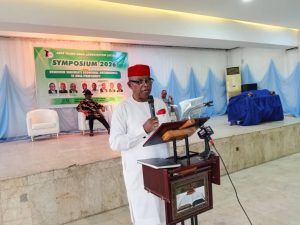
These words were the stark reality Chief Chuku Wachuku laid bare as he set the tone for the Abia Think-Tank Association (ATTA) Annual National Dialogue in Lagos as the Chairman of the occasion.
For him, Abia’s story is “not one of absence, but of constraint.”
Read Also: The Truth About Constant Faults On The Aba–Itu 132kV Transmission Line
It is this contrast, between visible enterprise and underlying limitations, that formed the basis of conversations at the dialogue, where stakeholders gathered on Saturday, March 21, 2026, to confront a critical question:
Is Abia prepared for Nigeria’s economic resurgence?
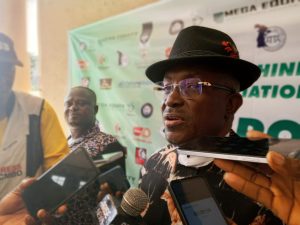
To tackle this question, the President of the Abia Think-Tank Association, Mazi Samuel Ohuabunwa, emphasised that the essence of the symposium is to serve as a strategic platform for confronting hard truths and charting a pathway toward sustainable development in Abia State.
He noted that over 20 years, the forum has gathered elites from Lagos, Abuja, and the diaspora to deliberate on issues affecting the state’s economic, political, and social sectors, as well as propose actionable solutions.
Apart from this, Ohuabunwa revealed that the gathering has been instrumental in supporting Abia governance, citizens, and businesses, through the ATTA summits, school enlightenment and voter education programmes every election year, and other initiatives the association has undertaken.
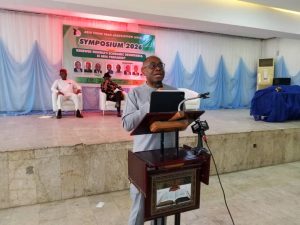
However, the President expressed displeasure over the recurring challenge in Abia State, saying that despite Nigeria’s growth and Abia’s potential, progress is often slow because attention focuses more on problems than opportunities.
“Often our focus is on the problems, so much so that our people are always doing the catch-up”.
He noted that while external factors sometimes marginalise Abia, the state also marginalises itself by failing to recognise and act on emerging opportunities.
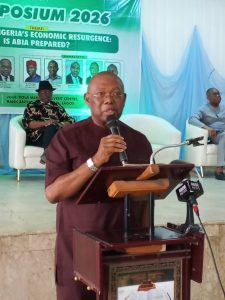
Amid the critique, Ohuabunwa offered a note of hope. He lauded the proactive governance of Governor Dr Alex Otti for creating an environment ripe for progress.
But he was quick to caution that opportunities alone are not enough; they must be met with awareness and action.
“Luckily for us today, in Abia State, we have a government that seems to be proactive, but we need to know what the policies and programmes are in place to take advantage of the changes on the horizon, “ the President urged.
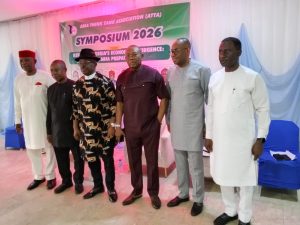
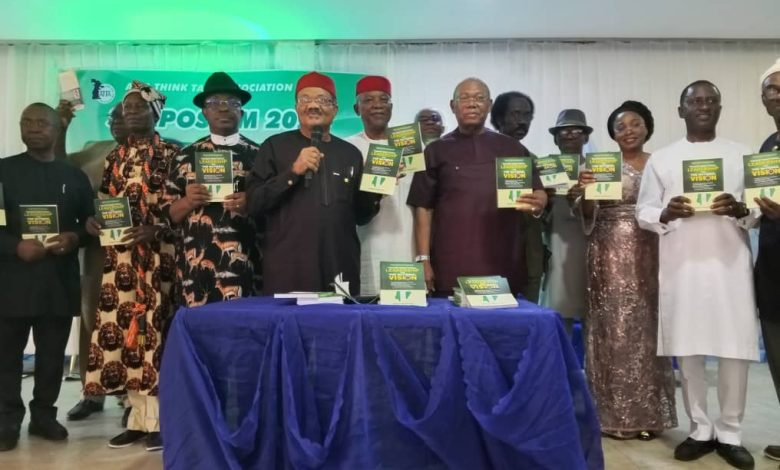
(2nd left), Chief of Staff, Pastor Caleb Ajaba and Chief Chuku Wachuku (middle), Dr Mazi Uche Orji (2nd Right) and Dr. Uche Ogeh (1st right)
Adding a sharper lens to the discussion, the Chairman of the occasion, Chief Chuku Wachuku, President of the Agricultural and Industrial Entrepreneurs of Nigeria (AMEN) and former Director-General of the National Directorate of Employment (NDE), offered a striking diagnosis of Abia’s challenges.
“Abia does not have a productive problem; Abia has a conversion problem,
“We convert effort into survival, but not wealth. We produce, but do not fully process. We create, but do not fully scale. We work, but do not fully capture value.”
His critique extended to political leadership:
“They distribute tools, give out grants, and announce interventions, but rarely build systems. Empowerment that creates dependence, not capacity.”
He stressed that lasting growth is systemic, not performative, noting that businesses thrive when preparation is built deliberately, consistently, and collectively.
In response to the critiques and challenges highlighted, the Governor of Abia State, Dr Alex Otti, outlined the deliberate steps his administration is taking toward economic repositioning, anchoring his argument in measurable progress.
Otti, who was represented by his Chief of Staff, Pastor Caleb Ajaba, revealed that over 1,000 kilometres of roads have been constructed since the administration took office, alongside improved security conditions across the state.
In the energy sector, he noted that nine local government areas now benefit from steady electricity through the Geometric Power project, marking a shift toward a more reliable power supply.
On investment climate reforms, he pointed to a significant rise in efficiency, with more than 4,000 Certificates of Occupancy issued between June 2023 and March 2026, a figure that surpasses what was recorded in decades prior.
Abia’s ease of doing business ranking, once positioned around 32nd–33rd in 2022, has also seen notable improvement.
The governor further highlighted gains in human capital development, noting that about 2,550 young people have been trained in ICT skills across three cohorts, while the state attracted over $150 million in foreign direct investment in 2024 alone.
These, he said, reflect a broader strategy aimed at positioning Abia as a competitive destination for investors.
Beyond the figures, he stressed that investors are driven by structure, not sentiment, underscoring ongoing efforts to build systems that support long-term growth.
He also emphasised prudence in resource management and called for greater participation of capable, experienced individuals in governance.
Reinforcing the governor’s position, the keynote speaker, Mazi Uche Orji, deepened the conversation with a data-driven argument that places Abia at the centre of Nigeria’s economic resurgence.
The former Managing Director and CEO of Nigerian Sovereign Wealth Limited described Abia State’s role in Nigeria’s economic resurgence as being shaped by its resource strength, entrepreneurial base, strategic location, governance reforms, and emerging industrial platforms.
“The place of Abia State in Nigeria’s economic resurgence is defined by five structural realities: its resource endowment, its human capital and entrepreneurial tradition, its geographic and commercial centrality, its institutional transformation under Governor Otti, and its capacity, through the Enyimba Economic City and related platforms, to serve as a national engine of economic diversification.”
According to him, Abia’s economic foundation is both vast and under-leveraged.
Orji describes the state hosting 57 active oil wells, which produce about 60,000 barrels per day, with oil and gas contributing over 39 per cent of its GDP.
In agriculture, the state accounts for 27 per cent of GDP and employs 70 per cent of the workforce, further underscoring its productive capacity.
He pointed to the $200 million oil palm investment by Presco Plc, spanning 14,000 hectares and projected to create over 5,000 jobs, as a clear example of how the state is beginning to convert raw resources into structured economic value.
Orji also highlighted the enduring strength of Aba’s industrial ecosystem, anchored by Ariaria International Market, home to an estimated two million traders and over 37,000 stalls, as well as a network of resilient manufacturers producing goods that serve markets across West and Central Africa.
This, he noted, explains why Abia ranks among the top five most industrialised states in Nigeria and holds one of the country’s highest human development indices.
Beyond production, the keynote speaker emphasised Abia’s geographic advantage, noting that the state connects 11 states within a 150-kilometre radius, giving it access to a market of nearly 60 million people, a position further strengthened by opportunities under the African Continental Free Trade Area.
On governance, he aligned with earlier remarks by pointing to measurable reforms under Alex Otti, including the growth of internally generated revenue from ₦20 billion to a projected ₦100 billion, improved ease of doing business rankings from 33rd to 21st, and widespread infrastructure and power improvements across communities.
Central to his argument was the emergence of the Enyimba Economic City, a 9,803-hectare special economic zone backed by the Federal Government, as a potential game-changer.
With $150 million already committed by Afreximbank and interest from over 76 international companies, he described it as Nigeria’s most compelling platform for capturing global manufacturing opportunities.
Taken together, he argued, these indicators point to a state that is not merely preparing for economic resurgence but actively shaping it, transforming its assets, institutions, and opportunities into a coordinated growth strategy.
In a panel session that followed, prominent Abia indigenes further interrogated the theme, offering industry-based insights into the state’s economic prospects. Contributors included Uche Ogeh, Managing Director/Chief Executive Officer of Masters Industrial Group; Johnson Chukwuma, MD/CEO of Cowry Assets Management Limited; and Sam Onukwue, MD of Mega Equity Limited.
The gathering also featured a book launch, adding an intellectual flourish to the discourse. The work, authored by Moses Kalu, was unveiled to the audience, further enriching conversations around Abia’s development trajectory and offering a reflective contribution to the ideas shaping the state’s economic future.
As the forum drew to a close, one question resonated throughout: Is Abia ready for Nigeria’s economic resurgence? The answer, the discussions suggested, lies not in rhetoric or promise, but in structure, systems, and deliberate action.
Beyond the speeches, statistics, and projections, the forum underscored a deeper truth: growth is not incidental; it is engineered through policies that work, institutions that function, and opportunities that are deliberately harnessed.
Ultimately, the forum made it clear: Abia is not waiting for Nigeria’s resurgence; it is positioning itself at the centre of it, proving that with the right structures in place, the state can not only participate in the nation’s economic revival but help drive it forward.
As the ATTA’s President declared, ‘Abia is rising, things are changing; even the blind can see, and the dumb can hear.’