“Argument is meant to reveal the truth, not to create it” – Edward the Bono.
With the International Court of Justice’s ruling, Cross River State was left drowning in the Bermuda Triangle. Approximately two decades from now, a Phoenix appears to have risen from the debris of history to reopen closed files.
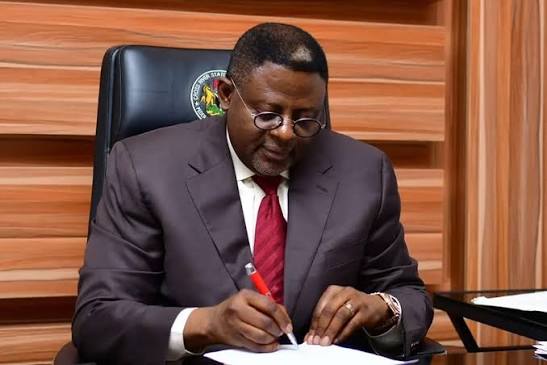
He is the “Sweet Prince”, Sen. Bassey Otu, governor of Cross River State. Victory for him in the renewed battle shall mean more than a pyrrhic victory for Cross River, a once oily State now designated as “landlocked”, condemned to benefit from petrodollar. Prince Bassey Edet Otu, who for two straight decades, 2003 – 2023 – served consecutive two full terms in both Chambers of the National Assembly, posits that he “joined politics not for power, but for service to humanity.”
In all fairness, the Cross River State situation is haplessly and helplessly ironic and pitiable: an aboriginal, bona fide and ancestral entity of the memorable COR State Movement of the 60s in the oil-rich Niger Delta Region of Nigeria, yet without a drop of the black gold. And this is happening in a country where everyone and everything depends on crude. The painful truth is that the State once had oil, but now, it is not even named amongst the about 154 oil-bearing communities in 11 States of the country. More painful perhaps, distant non-core Niger Delta States like Abia, Imo, and Ondo sit comfortably with big eyes in the Niger Delta Development Commission (NDDC).
Look at even Anambra, and more so, Kogi State, which is sitting on granite rock. In a letter dated 24th August 2024, signed by the Secretary of the Revenue Mobilisation Allocation and Fiscal Commission (RMAFC), M.B.Shehu, the two neighbouring States were acknowledged and admitted into the oil-producing league of States just because some struggling tiny streams of oil meander through corrugated surface pipes in their red soil backyard. Anambra is reported to have 11 oil wells (Nzam 1, Alo 1, Ogbu 1, Aleshi 1,2,3 &4; Enyie 1, 2,3, & 4. While Kogi boasts of River 1&2 in Aqueilary Oti and Ibaji, a traditionally notorious hotpot of communal conflicts over ownership of oil. It must pain Cross River to see Anambra and Kogi going to Abuja every month-end for a share of 13% derivation and 3% benefit for Host Communities as granted by the Petroleum Industry Act (PIA) – just because they contributed two or three spoonfuls of oil to the nation’s tank farm.
And Cross River, with a wet ass in the Atlantic, has nothing to boast of. To the extent I know, the Cross River dilemma is not strictly a case of misfortune or of arm-twisting. It is, dialectically, that of reversed fortune occasioned by vicissitude and boomerang international diplomacy of Nigeria’s elite. Unlike the past, Otu does not understand what his predecessors understood in their days or what they may have hoped to gain from fair play championed by Chief Olusegun Obasanjo over Bakassi. It sounds like almost saying that Donald Duke, Liyel Imoke, Prof. Ben Ayade, were easygoing, improvident royal cowboys by their misinterpretation of the crude reality that a Cross River without oil could be grovelling for survival in the comity of States. As Chinua Achebe tells us in Things Fall Apart, it is like standing inside a river but washing your face with spittle.
To Chief Otu, as I read his lips, the ceding of Bakassi to Cameroon, with all the rich ingredients, was a tradeoff with collateral impact.
Read Also: A’Ibom: Ekid People Reject Govt. Committee On Stubb Creeks Forest
Although he knows and cannot deny the history that brought his state into this conundrum, the governor is aggressively embarking on adventurist revisionism. He is determined to challenge, hook and crook, even sacrosanct precedents, to reverse the records. What I cannot tell is if the ambitious governor has by now consulted Edmund Hillary of New Zealand and Nepali-Indian Sherpa Tenzing Norgay on what it took them to get to the smoking nipples of the 8,848 metres Mount Everest on May 29, 1953, to make history? Another worry is the extant principle of time sequence in pursuing a legal case.
The Genesis
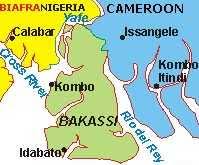
One dictionary defines a peninsula as “a piece of land almost surrounded by water or projecting out into a body of water”. History holds that disputes between Nigeria and Cameroon over the Bakassi peninsula date back to 1913, 1931, 1981, 1994 and 1996. At long last, the matter was referred to the International Court of Justice, and on 10th October 2002, that Court ruled in favour of Cameroun. As if to twist the knife, by virtue of geography and nautical miles, Cross River automatically lost all its oil wells.
The Green Tree Agreement
Although the consensus was reached in 2002, it was not until June 12, 2006, that President Olusegun Obasanjo and his Cameroonian counterpart, President Paul Biya, officially signed the Greentree Agreement. The ceremony took place at the Greentown Estate in Manhasset, New York, USA. Former President Olusegun Obasanjo was arguably Nigeria’s principal negotiator or catalyst. He was then the president. The name Green Tree is taken after a place in Allegheny, Pennsylvania, a suburb of Pittsburgh in the United States of America. The area was created in 1793. It was the international legal battleground for the disputes between Nigeria and Cameroon over Bakassi.
Cross-border Retreat
This mutual engagement was followed up with the gradual withdrawal of troops from the hot spot by the Nigerian government and the official transfer of full authority over the meaty portion of Bakassi to the Cameroun government. Details of the processes included the first three months or 60 days granted to Nigeria for the withdrawal of her troops and an additional 30 days to cover exigencies; while Nigeria was still allowed to temporarily maintain her civil administration and police in Bakassi for another two years to checkmate possible break of order. To ensure compliance, an ad hoc committee comprising representatives from Cameroon, Nigeria, the United Nations, the United States of America, France, Germany and the United Kingdom was constituted to monitor proceedings and actual implementation of the recommendations. While the effects of the agreement were composite, it was expectedly hardest on Cross River. More expressively, Cross River was no longer to be seen as an oil-producing area of the Niger Delta, nor to deserve or attract any benefits.
The Backlash
The ruling of the International Court was received with mixed feelings by many a Nigerian, a section blaming the federal government for docility, reckless haste, and cheap capitulation. To Cross Riverians in particular, it was a sellout. Former Special Adviser on Media and Chief Press Secretary to former Governor Ben Ajade, Mr Christian Ita, noted that the Cross River State government had in 2015 instituted a N3trillion suit against the federal government for the loss of Bakassi (See Guardian Newspaper, 20/10/2019). Preponderant opinion was that the Treaty was poorly consummated. There was the imminent burden of accommodating the influx of returnees from Cameroon. By 2017, as Mr Ita further revealed, only about 38 billion of the said amount may have been disbursed.
Incidentally, the ruling came just a year after the birth of the Niger Delta Development Commission (NDDC). Curiously, till today, Akwa Ibom with a thousand oil wells, is without a single refinery. It still lifts petroleum products from Calabar or Port Harcourt.
Post-Agreement Period
A littoral state is defined as one that borders an ocean, sea, or lake, having direct access to water. Cross River hates this appellation. So, even with the judgment of the Supreme Court, the State still went to court. The bone of discontent was the ownership and revenue rights to the 76 oil wells located off its coasts, which affected its littoral status. The case was before their Lordships: Dahiru Mustapher CJN; Mahmud Mohammed JSC; John Afolabi Fabiyi JSC, Olufunlola Oyelola Adekeye JSC, Suleiman Galadima, Bode Rhodes-Vivour JSC, and Nwabali Sylvester Ngwuta JSC. The parties were Attorney-General, Cross River State (Appellant); Attorney-General of the Federation and Attorney-General, Akwa Ibom State (Respondents).
The Court was to decide whether there existed a boundary adjustment issue between the plaintiff (Cross River) and the 2nd defendant, Akwa Ibom State, if the former is entitled to derivation revenue from the 76 oil wells hitherto considered part of Cross River’s maritime boundary.
Supreme Court Decision (2012)
Twice, the Supreme Court held categorically that for a state to be classified as a littoral state entitled to revenue from offshore resources, it must have direct access to the sea. So, the Supreme Court affirmed the ruling by the International Court of Justice. The judgment thus nullified claims by Cross River, as it were. Accordingly, with raking up of the case by Gov Otu in 2025, his Akwa Ibom counterpart, Pastor Umo Eno, had advised him that he is riding a dead horse; indulging in pandering of sentiments and propaganda. Akwa Ibom holds firmly and unapologetically to two favourable judgments of the Supreme Court over this matter. The Dead Horse Theory states that, “When you discover that you are riding a dead horse, the best strategy is to dismount.”
Pastor Umo Eno, as a Matter of Fact
“There are two Supreme Court judgments that give Akwa Ibom State the right to those oil wells. We are not sharing maritime boundaries with Cross River State but with the Republic of Cameroun, and the Nigerian Supreme Court has said so twice to establish this fact. Facts are sacrosanct, and you cannot push them under the carpet with sentiments”, he explained during an interview.
Prince Otu and co. think otherwise. I find an interesting argument by one Otuekong Offiong Andem Bassey, a Strategic Communications & Public Affairs Analyst, titled “RE: FACTS, LAW, AND THE DANGERS OF POLITICAL MISREPRESENTATION IN THE OIL WELLS MATTER”, as published on social media. In his rejoinder to a press statement earlier issued by the Akwa Ibom State government, Bassey, apparently a Cross Riverian, wrote:
“What is before the nation today is not propaganda, not sentiment, and certainly not an appeal against judicial authority, but a long-overdue scientific, technical, and factual verification exercise initiated by the Federal Government itself. It is important to remind the public that the 2012 Supreme Court judgment did not award, transfer, or ascribe the 76 oil wells to Akwa Ibom State. Rather, the Court struck out Cross River State’s claim to an offshore maritime boundary beyond the 200-metre isobath following the International Court of Justice decision on Bakassi. Crucially, the Supreme Court directed relevant federal agencies, including RMAFC and others, to verify and properly ascribe the oil wells based on factual location”.
Contrary to his claims, Otuekong Bassey now faces the dilemma of agreeing or disagreeing with Obong Victor Attah. In a recent interview on ARISE TV, Obong Attah reminisced:
“The only reason Cross River was ever regarded as a littoral state was that it had direct access to the Atlantic Ocean through Bakassi. But with the International Court of Justice (ICJ) ruling and the Green Tree Agreement, Bakassi was ceded to Cameroon. That immediately left Cross River landlocked, with only a few islands, and therefore no longer a littoral State. Oil wells belong strictly to the state in whose territory they fall. If they lie within Akwa Ibom boundaries, they belong to Akwa Ibom. Nobody has ever provided proof that Akwa Ibom is drawing revenue from Cross River oil wells. Boundaries decide ownership, not sentiments.
Mutatis mutandis, Gov. Bassey Otu must find a distinction between adventure and adventurism. The heavy weight of proof rests on his shoulders. Interestingly, with recent moves involving both Umo Eno and Bassey Otu and Big Brother Senate President, Sen. Godswill Akpabio, pundits are already foreseeing a political solution to this impasse. Whatever that shall be.
Cross River, having survived these years without oil revenue, cannot be taken lightly. The governor, therefore, strongly believes there is a way out. Although carrying a Sisyphean burden, he is giving hope to Cross Riverians. The coded message he is flaunting to the world is that he knows where the skeletons of this closed matter were buried in Bakassi, and he is on a curious mission to exhume them, breathe life into them, and become a miracle worker. At best or worst, if Cross cannot break through with crude, it should make a case with palm oil. No matter what happens, brothers must be careful that stones are not thrown into a basin of palm oil at the gathering of kindreds or a catapult shot into a market! This was re-echoed by Gov Umo Eno during a recent Special Worship at Helen Ukpabio’s Liberty Church in Calabar.
“The people of the two states will continue to be brothers because of our bond. Our unity, oneness and peace have always been our goal,” the Golden Boy said.
But if Chief Bassey Otu, against the odds, ultimately succeeds in this irredentist quest, it will be one of the biggest scores of his public service memories. His people then should prepare to make a statue of him at the 11:11 cenotaph in the heart of Paradise City. Otherwise, Prince Otu may have to take as a placebo Marcus Cicero’s prescription: “When you have no basis for an argument, abuse the plaintiff” – and damn the consequence!