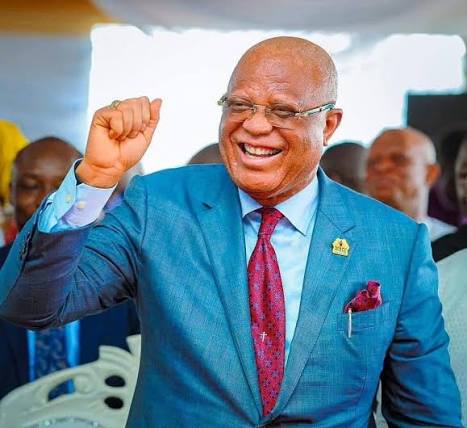
“As we stand today, we have not in the last two years borrowed a dime from anybody. We have been building a savings pool from funds that came to us to be able to finance our projects and development seamlessly.” – Gov. Umo Eno, at his investiture as Patron of the Nigerian Institute of Public Relations, on May 22, 2025, in Uyo, Akwa Ibom State.
Citizens are happy. Governor Umo Eno is constantly and enviably attracting headlines in local and national dailies. He is aggressively fulfilling campaign promises as embedded in the ARISE Agenda, an integrated blueprint and working document designed to guide his administration’s policies and approaches to translating promises into reality. He is walking the talk.
ARISE Agenda, the compass of action, was launched on July 27, 2023, barely a month after he assumed office as the 4th Executive Governor of Akwa Ibom State on May 29, 2023 (since the return of democracy in 1999). ARISE Agenda encapsulates multiple subunits that fully define it as a one-stop instrument of translatable actions for the desired goals and impact. Thus, the ARISE Agenda comprises – Agricultural Revolution, Tourism, Sports/Social Development and Environmental Management; Rural Development, Women and Youth Empowerment; Infrastructural Maintenance, Advancement and ICT Development; Security Management, Sound Educational and Health Sector Management; Economic/Industrial Advancement and Wealth Creation.
Since its formal launch, the governor has meticulously followed a systematic and analytical interpretation of the instrument. This, expectedly, has resulted in the vertical progress or the multidimensional positive developments that Akwa Ibom has witnessed since May 29, 2023, across all sectors of the state economy. Driven by character, integrity and tenacity of purpose, the pastor-politician is rapidly meeting expectations and the needs of the people. The secret is easily traced to his transparency, accountability and consequential impact, made more sustainable by mechanisms put in place to monitor implementation and step-by-step progression of ongoing projects and execution of administrative policies at all levels.
There is growth and development in the land. The people are excited because the administration has made them an integral part of governance processes that are essentially inclusive, integrationist, emancipatory, participatory, and populist, and therefore altruistic. Hence, not the slightest space has been left for grumbling amongst the indigenes, who on a daily basis are rolling out the drums and flutes in testimonies.
Related: Governor Eno, Microfinancing and The Roaring Engine of Entrepreneurship
Coming into the leadership and governance of the state from the private sector, where he already was a cynosure and paragon of successful talk-about private enterprises, Pastor Umo Eno was fully aware of the positive effects of transparency and the lack of it in leadership management. He knew that without transparency in actions and in the execution of plans and objectives, too many questions would be asked by the masses without appropriate and convincing answers.
Early enough, Pastor Eno instituted transparency/accountability as a coat of arms to influence impact. For instance, even in the appointment of members of the executive council, he banished nepotism, cronyism and favouritism and rather enthroned meritocracy that is definable by competence and results. He announced on the radio that nobody should influence his choice of those he appoints to work with, since sentiments and tribal connections were not to be part of it. He went for the best.
Pastor Umo Eno also applied that in the manner he has allocated or spread the appointments to capture equity across the 31 local government areas of the state. That eased off the tension or rancour. Local governments that may not have been captured to form part of the exco were allocated competitive top-notch offices that were significantly connected to the exco.
Next, to ensure accountability, the governor revitalised the Financial and General Purposes Committee (FGPC), a financial regulatory instrument that sets thresholds and monitors expenses in Ministries, Departments and Agencies (MDAs) towards effective and transparent propriety. Those who criticised the governor for having started too slowly in early June 2023 soon got convincing reasons.
Speaking on August 19, 2023, during the Government House prayer meeting held at the Latter House Chapel, the governor noted: “We will flag off some road projects soon. Why we did not do it before was that the amount was more than what I could have approved solely as governor. I am a very procedural person. We needed to constitute the Financial and General Purposes Committee (FGPC) to get the approval before the award of the contract for projects. I know people were watching. If you award a contract before doing those things, the House of Assembly will come after you. So I am also careful. ”
The accountant-general of the state, Pastor Uwem Andrew, corroborated the governor’s position when, days later, he told newsmen that no contract was considered valid and executable if it had not passed through the needle-eye scrutiny of the FGPC. “If a project does not have a vote of charge in the budget, you cannot get money anywhere,” he disclosed, showing how strict it must be to misappropriate funds.
Soon came a phenomenal and rapid all-sector development that shocked the Akwa Ibom people for good. With FGPC now in place, new contracts were not only awarded, but contractors were also promptly mobilised to sites with strict, non-negotiable deadlines for completion. To further dignify the principle of continuum as an aspect of succession in leadership, priority attention was also given to projects either uncompleted or abandoned by previous administrations. This must have accounted for the seemingly little delay in the full commencement of brand new mega projects. It paid off on all fronts. Akwa Ibom State became a huge construction site.
First, for equity and fairness, the governor allowed all 31 local government areas in the state to choose at least one project between a model primary school and a health centre, to be constructed within record time and commissioned by the government. That was complemented with a general and massive siting and allocation of other infrastructural projects across the state. Today, except for one, which was determined to be mischievous and ungrateful, it can be argued that there is no local government area that has not benefited from at least two projects by the current administration.
While capital projects and infrastructural development were going on, there were fresh waves of policy reviews. Attention was given to the civil service, the welfare of retirees and pensioners, education, healthcare, human capacity development, the uplift of the Compulsory and Free Education Policy of the State, bursaries and the award of scholarships to students. Others include the sophisticated upgrade and revival of dormant tourism potentials; priority to agriculture and establishment of a Bulk Purchasing Agency as a buffer to curb the high cost of foodstuffs; aviation development; marine sector renaissance; attention to security; compassionate homes for the elderly and monthly allowances, etc.
Then the launch of the Town Square meetings served as a functional approach for the governor to reach the masses directly, hear them, collate and document their pressing needs, galvanise modalities, and devise methodologies to ensure that dividends of democracy were evenly spread to all parts of the state.
There is something else that has further proven Gov. Umo Eno’s commitment to transparency, accountability and impact. With the Supreme Court judgement in July 2024 that granted autonomy to local government, the governor was among the first to welcome and commend the apex court for the decision, which he said will aid in the rapid transformation of local government areas. Although the governor expressed doubts over the ability of some local governments to meet their obligations on the residual list, he also said something notable about his character and accountability. “The Supreme Court has made pronouncements. That’s the final court of the land. But for us in Akwa Ibom, honestly, I don’t see us having any issues. It is a relief to the state government. Since I assumed office, I’ve not touched any funds allocated to the local governments”.
At the presentation of the Socio-Economic Impact of the ARISE Agenda last year, which had the theme “Measuring Progress, Deepening Impact”, the governor therefore was not making boasts but bold and verifiable statements of facts when he said, “Through various projects executed by government across sectors, we have created jobs and got thousands of our people out of poverty in line with the SDG goals. Over 50 audacious projects are currently ongoing, and we are doing all these without borrowing from the banks. These projects are fully funded because we have decided that we will use the resources of Akwa Ibom State to work for the Akwa Ibom people – not for individual or group interest. We are also, by this event, demonstrating in practical and concrete terms our passionate commitment to transparency and accountability.
Socio-economic theorists define good governance by the following basic indicators: Rule of law; Transparency and accountability; Citizenship participation in the democratic process and governance; Responsiveness, Equity and inclusion; Effectiveness and efficiency; Political will for action and goodwill. For these to work optimally, social engineers have also listed the most dependable and cogent requirements to include political stability, strengthening institutions, combating corruption, and running an open-door policy where citizens are free to ask questions and get answers. All these have become the norms, the creed, of Governor Eno in his style of leadership.
The choice of Governor Umo Eno for the prestigious award of the “Governor of the Year 2025” by the Nigerian Governors’ Forum, a body comprising all 36 governors in the country, is a national and unanimous testament to the superior performance of a leader who has demonstrated transparency and accountability, which have resulted in evidential and altruistic impact.