New, Inherited Infrastructure Projects Being Executed by Gov Eno Gulps N879.22bn – Works Commissioner
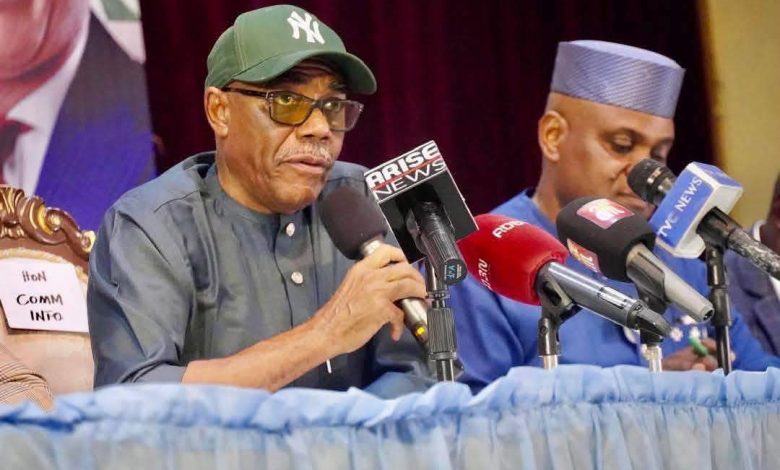
Over N879.22 billion has been spent by the Akwa Ibom State Government on infrastructure projects initiated by Governor Umo Eno and those inherited from the previous administration.
Commissioner for Works and Fire Service, Prof. Eno Ibanga, has disclosed this during a ministerial briefing at the Akpan Isemin Hall, Government House, Uyo, on Thursday, September 17, 2026, where he presented the scorecard of the Ministry.
Prof. Ibanga said N747.51 billion had been spent on projects initiated under the administration’s ARISE Agenda, while N131.71 billion had gone into inherited projects.
He explained that N615.65 billion was released for 76 Finance and General Purpose Committee (FGPC) projects, while N131.68 billion was spent on 53 emergency intervention projects, bringing expenditure on ARISe projects to N747.51 billion.
The Commissioner said the administration had also funded 105 projects inherited from the previous government, comprising 47 FGPC road projects involving 14 bridges, 51 direct-labour projects, and seven other interventions covering erosion control, electrification, and related works.
Read Also: Gov Eno Tasks Delivery Advisors, Contractors On Specifications And Projects Completion
He said 57 of the inherited projects had been completed, with 15 already commissioned by the present administration.
On projects initiated by the Eno administration, Ibanga said 129 ARISE FGPC and direct-labour projects had been undertaken, comprising 114 road projects and 15 erosion control, electrification and other interventions.
Of these, he said 26 had been completed, while 20 had been commissioned.
The commissioner said the administration is currently handling 234 projects covering roads, erosion control and electrical interventions, with 40 bridges and 1,159.63 kilometres of roads at various stages of completion.
“His Excellency, the Governor, Pastor Umo Bassey Eno, has executed and funded a total of 234 projects with 40 bridges totalling 1,159.63 kilometres, while 43 RAAMP projects cover 352.83 kilometres across the state,” Ibanga said.
The 43 Rural Access and Agricultural Marketing Projects (RAAMP), being implemented with support from the World Bank in partnership with the state government, cover an additional 352.83 kilometres.
The combined figure, according to the commissioner, brings the length of roads under the state government’s current projects to 1,511.83 kilometres.
He said the projects covered the design, construction and maintenance of state roads, bridges and culverts, as well as erosion control, electrification and other infrastructure interventions.
Ibanga said road maintenance remained a major part of the ministry’s activities, with 123 potholes and failed portions of roads identified and repaired or overlaid across the state.
In Uyo metropolis, he said 41 locations had been treated, covering more than 6,387 square metres of overlay works and 4,060 square metres of patching.
He also identified erosion control as one of the administration’s major infrastructure interventions.
According to him, the ongoing Uyo Village Road project is designed to address some of the erosion and drainage problems in the state capital.
The project involves the dualisation of about 4.3 kilometres of road, construction of two bridges and reclamation of erosion-prone areas, including a former dump site.
Ibanga said the project was expected to recover more than 150 hectares of land for planed urban development.
He explained that the intervention would not only improve transportation but also open up areas that had been affected by erosion and other environmental challenges for future development.
Responding to questions on the state of the Tabernacle Road, Ibanga said the government had taken steps to resolve issues delaying the project.
“I was directed by His Excellency to meet with the contractor and liaise with him. People’s property has been paid for, compensation has been paid for, and we are going to clear the corridor,” he said.
The commissioner explained that the persistent rainfall had affected construction work on the road, adding that asphalt could not be laid until the moisture content of the road was reduced.
He added that approvals had also been obtained for the Nkemba and Ukana Offot roads, with the projects awaiting award.
The Commissioner for Works noted that about 15 to 16 road projects had been awarded in 2026, adding that the government was determined to complete them before the end of Governor Eno’s second term.
He said the administration had also executed internal road projects in Eket and distributed road projects across the state, with each local government getting at least 10 kilometres of road.
The commissioner said the distribution of road projects was based on needs assessment across the state, with the administration targeting a minimum of about 10 kilometres of road construction in different local government areas.
He, however, acknowledged that some local government areas, including Ibeno and Udung Uko, had recorded shortfalls in road construction, attributing the variations to the specific needs identified in those areas.
On urban street lighting, the commissioner said the administration had installed 6,386 solar-powered streetlights out of the 6,441 approved under Phases I and II of the project.
He said the transition from diesel-powered generators to solar energy had reduced the volume of diesel required to operate the streetlights.
According to him, monthly diesel consumption had fallen from 150,000 litres to 32,000 litres.
“Before migration to solar, diesel consumption was 150,000 litres per month; that is N187.5 million per month. After migration, it is now 32,000 litres per month; that is N40 million per month. The reduction represents a reported 78.7 per cent drop in diesel consumption,” Ibanga said.
Ibanga also disclosed the completion of a 1.1MVA generator installation and a 1,500KVA dedicated substation at the State Secretariat Annex.
He said the project had connected the facility to the national grid for the first time since its establishment.