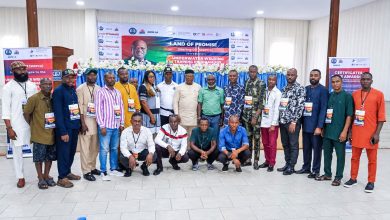

The joyful smiles, heartfelt prayers, and quiet expressions of relief that greeted the distribution of 7,000 bags of rice and beans in communities across Akwa Ibom State told a story that extended far beyond food assistance. They reflected the growing impact of Governor Umo Eno’s humanitarian governance philosophy, one that places the welfare of vulnerable citizens at the centre of public policy.
From the riverine communities of Okobo and Esit Eket to the agrarian settlements of Nsit Ubium, Nsit Atai, Essien Udim, Ika and Ini, thousands of vulnerable households are benefiting from the fourth phase of the ARISE Free Food Distribution Programme, a flagship intervention designed to cushion economic hardship and strengthen social protection.
It has become one of the defining pillars of Governor Umo Eno’s ARISE Agenda, complementing the Federal Government’s Renewed Hope Conditional Cash Transfer Programme, with the Ministry of Humanitarian Affairs facilitating beneficiary mobilisation and verification.

In an era of rising food prices, the administration has continued to demonstrate that governance is measured not only by infrastructure but also by policies that directly improve the lives of the poor, the elderly, persons with disabilities and widows.
After successfully implementing three phases with 5,000 bags allocated to each local government area, Governor Umo Eno approved an increase to 7,000 bags under the ongoing fourth phase. By the completion of the exercise, about 217,000 bags of food would have been distributed across all 31 local government areas of the state.
Read Also: ARISE Care and Share Programme Targets Those Yet to Benefit from Akwa Ibom State Empowerment Schemes
Coordinated by the Ministry of Humanitarian Affairs under Commissioner Princess Emem Ibanga, the programme has been implemented with the Akwa Ibom State Bulk Purchase Agency, local government councils, Ward Personal Assistants and councillors, resulting in orderly, transparent distribution across the state.
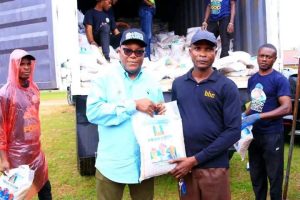
Princess Ibanga said the intervention reflects Governor Umo Eno’s determination to cushion economic hardship while the administration invests in agriculture to guarantee long-term food security.
The state government has also worked closely with the federal government to facilitate the Renewed Hope Conditional Cash Transfer Programme in Akwa Ibom.
Under the programme, eligible beneficiaries captured in the National Social Register receive debit cards loaded with ₦75,000. Nationally, more than 650,000 households benefited during the first phase, while the ongoing phase targets about 217,000 additional households.

The impact was particularly evident in Essien Udim Local Government Area, where 2,450 beneficiaries received more than ₦183.75 million during the flag-off of the Conditional Cash Transfer exercise.
Addressing beneficiaries, Princess Ibanga described the programme as evidence of productive collaboration between the federal and Akwa Ibom State governments and encouraged residents to obtain their national identity numbers for the national social register.
The chairman of Essien Udim Local Government Council, Hon. Ntiedo Usoro, described the intervention as a practical demonstration of the synergy between President Bola Ahmed Tinubu’s Renewed Hope Agenda and Governor Umo Eno’s ARISE Agenda.
The most memorable moment of the event, however, came from the reaction of one beneficiary. Mama Helena Jonah Udofia of Adiasim Ikot Essien Ndon broke into spontaneous dance after receiving her debit card, offering prayers for President Tinubu, Senate President Godswill Akpabio, Governor Umo Eno, and the local government chairman.
That sense of gratitude has echoed across the state. In Nsit Atai, Mrs. Emem Smart, Mr. Caleb Asuquo Williams, Mrs. Esther Ben and Mr. Mfon Godwin were among the residents who received bags of rice and beans under the fourth phase. In Okobo, heavy rainfall failed to discourage elderly residents, pregnant women, nursing mothers and persons with disabilities from gathering at the council headquarters to receive food items.
Mr. Francis Okon, Madam Esther Timothy, Mrs. Uduak Okon, Mr. Monday Effiong, Queen Morris and Mr. Ekpenyong Ekong were among those who collected food items at the Okobo Local Government headquarters.
The programme also recorded enthusiastic responses in Nsit Ubium, where beneficiaries praised Governor Umo Eno for increasing the allocation from 5,000 to 7,000 bags. The Chairman of Nsit Ubium Local Government Council, Hon. Alfred Charles said the programme reflects the true essence of compassionate governance.
Esit Eket residents equally welcomed the distribution of 7,000 bags across the ten wards of the local government area. During the exercise, Princess Ibanga announced that beneficiaries of the cash transfer programme would soon receive their debit cards.
The General Manager of the Bulk Purchase Agency, Rt. Hon. Unyime Etim, commended officials for ensuring peaceful, transparent distribution and stressed that adherence to the State Social Register remains central to the programme’s credibility.
The food distribution programme is not intended as a permanent solution to food insecurity. Rather, it is a strategic intervention designed to cushion the effects of economic hardship while the government pursues broader measures to strengthen food security across the state.
Recognising that no economy can overcome its challenges without a vibrant agricultural sector, the state government continues to encourage citizens to return to farming as the most reliable path to food sufficiency and shared prosperity.
To demonstrate this commitment, Governor Umo Eno has established the Ibom Model Farm and the Ibom Equipment Leasing Company, both designed to transform agriculture into a profitable enterprise by enabling farmers to access modern farm machinery at affordable rates, without the prohibitive cost of outright ownership.
This balanced approach reflects a government addressing both today’s realities and tomorrow’s demands. While the food distribution programme provides immediate relief, the administration’s sustained investment in agriculture is laying the foundation for increased productivity, job creation and economic stability.
As the food distribution programme continues across all 31 local government areas and the cash transfer programme progresses in the state, the impact of coordinated social protection is becoming increasingly visible. For thousands of vulnerable households, these initiatives are tangible evidence that responsive governance can provide relief in difficult times and reaffirm the confidence of citizens in public institutions.