
A’Ibom Records 1,838 GBV Cases, Secures 102 Convictions as Awareness Month Begins
By Ndifreke Enefiok, Uyo
More than 1,800 cases of gender-based violence have been reported in Akwa Ibom State since the enactment of the Violence Against Persons Prohibition (VAPP) Law. The data highlights the scale of abuse that continues to confront women, children and other vulnerable groups despite growing efforts to strengthen protection and accountability.
Official data released by the Sexual and Gender-Based Violence Response Department of the Ministry of Justice shows that 1,838 cases have been reported across the state since June 2020, while 102 convictions have been secured within the same period.
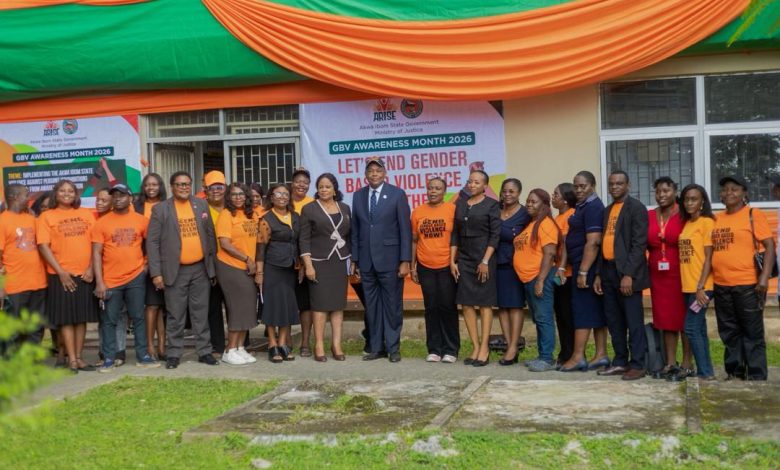
The figures were presented on Monday, June 1, at the Ministry of Justice during the flag-off of the 2026 GBV Awareness Month, an annual campaign designed to promote public awareness, strengthen survivor support systems and reinforce efforts to tackle violence in the state. The statistics reveal that 161 cases have already been recorded between January and May 2026 alone.
A breakdown of the figures shows that spousal battery accounted for 61 cases, threats to life and physical assault 46 cases, abandonment and forceful ejection from homes 18 cases, harmful widowhood practices 10 cases, while rape accounted for 26 reported cases. Beyond the 2026 figures, records from the Ministry indicate that reported cases have risen steadily over the years.
Between June and December 2020, the state recorded 69 cases. The figure increased to 141 in 2021, rose sharply to 316 in 2022, climbed to 368 in 2024 and reached 465 in 2024 before declining slightly to 318 cases in 2025.
Related: Int’l Women’s Day: Gov Eno Condemns Wife Battering, GBV, Rape
Speaking during the flag-off at the ministry, the Attorney General and Commissioner for Justice, Uko Udom (SAN), said the increasing number of reported cases should not be interpreted as evidence that violence is worsening.

According to him, the figures largely reflect a gradual breakdown of the culture of silence that prevented survivors from seeking help or reporting abuse.
“The silence is breaking. For decades, these crimes hid in the shadows of stigma, fear, and hopelessness. Today, the spike in reporting is a direct reflection of growing trust in our system. Survivors now believe that when they speak, the state will listen, act, and deliver justice. That trust has been earned, not given,” he said.
Udom said the theme of this year’s campaign, “Implementing the AKS VAPP Law: From Awareness to Action”, reflects the government’s commitment to move beyond public sensitisation to practical enforcement of the law.

He noted that while awareness campaigns remain important, the greater challenge lies in ensuring that survivors receive protection, offenders are prosecuted, and communities reject all forms of abuse.
Despite the progress recorded since the enactment of the VAPP law six years ago, the Attorney General expressed concern over what he described as persistent social and cultural barriers that continue to undermine the fight against GBV.
He criticised the practice of pressuring survivors and their families to abandon criminal complaints in favour of private settlements, warning that such actions often deny victims access to justice.

“When a man or woman’s ribs are broken, when a child is defiled, when a wife is battered unconscious, there is no ‘settlement’ that restores his/her dignity. What these words really mean is that money has changed hands, and justice has been buried. We reject this completely,” he stated.
He maintained that criminal acts of violence should not be treated as private family disputes and argued that justice cannot be substituted with financial compensation or community arrangements.
He called for greater consideration of survivor safety and witness protection when handling severe GBV cases, while emphasising the need to uphold the principles of fair hearing and due process.
Udom highlighted several measures introduced by the state government since the passage of the VAPP Law to strengthen prevention, response and prosecution.
Among them is the establishment of the Sexual and GBV Response Department in the Ministry of Justice to coordinate prosecutions, policy implementation and survivor support services.
He also disclosed that shelters and skill acquisition centres have been established to provide temporary accommodation, counselling and economic empowerment opportunities for survivors seeking to rebuild their lives.
Similarly, Udom revealed the state has equally established sexual assault referral centres in strategic locations to provide medical care, forensic support and psychosocial services for survivors.
He said GBV response structures have also been extended to all 31 local government areas to improve access to support services, particularly for survivors in rural areas, adding that traditional rulers, social welfare officers, community health workers and security personnel have received specialised training to strengthen reporting, referral and support across the state.
On her part, the Director of the Sexual and GBV Response Department, Barr Emem Ette, while speaking on the awareness campaign, said the event marked the official commencement of activities for the 2026 GBV awareness month.
She commended development partners, government institutions, and stakeholders for supporting efforts aimed at addressing GBV, urging for sustained collaboration to improve support services and expanded access to justice.