Akwa Ibom And The Irony Of An Oil-Producing State: No Refinery, No Fuel Depot 70 Years After
By Substance Udo-Nature

Statistics indicate that as of July 2025, Akwa Ibom was producing between 504,000 and 540,000 barrels of oil per day (bpd). This is the highest by a single state in the country presently, accounting for nearly one quarter of the country’s total crude production.
When we consider that oil exploration and exploitation started in the country in 1956, with export in commercial quantity taking effect in 1958, we can only imagine how much the area of geography called Akwa Ibom today and the entire Niger Delta have contributed to national development.
It is a fact that, by the economic principle of location and localisation of industry, the four refineries that Nigeria once had were primarily built on account of the stupendous natural endowments everywhere in the Niger Delta.
Shell, for instance, first entered Nigeria as Shell D’Arcy in 1956 and officially adopted the name Shell BP in 1956. That was after it successfully drilled Nigeria’s first commercial oil well, and the first shipment of oil from Nigeria began.
What about Mobil? The company had been on the ground in Nigeria as early as 1907, when it was largely involved in marketing operations. But it entered the upstream sector of the Nigerian oil industry in 1955 under the brand Mobil Exploration Nigeria Incorporated (MENI). However, Mobil came into the area called Akwa Ibom State in December 1961.
That was when it got its first offshore prospecting licences from the then Eastern State of Nigeria. By February 1985, Mobil had already hit the one-million-barrel mark of crude oil production. By the time the company divested from Nigeria’s shallow-water oil and operations officially on December 12, 2024, it already could have boasted of 90 platforms and 300 producing wells covering 3,200 square kilometres.
Related: 38 Years After, Akwa Ibom Still Dreaming Of First Refinery
The above retrospective references were to deepen the thrust of this essay in the light of what ought to have been in favour of a refinery or a petrochemical company for Akwa Ibom, but which never happened. Some benefits of a refinery or similar structures to a state include driving job creation, boosting Internally Generated Revenue (IGR), increasing local energy security, catalysing chain effects, and general multiple-layer growth and development, as well as improved livelihood of residents.
IN THE RECENT PAST
At least by utterances, momentum and optics, the closest Akwa Ibom ever came to the possibility of having a refinery sited in the state was in the days of former Governor Udom Emmanuel.
In other words, no governor of Akwa Ibom State, past and present, may have mulled the possibility or made fantastic, inconsequential moves towards the state having its own refinery or fuel depot like Mr Udom Emmanuel.
There was a three-day strategic retreat in Uyo, Akwa Ibom State, in November 2021 by the Upstream Directorate of the Nigerian National Petroleum Corporation (NNPC), then led by the Executive Director (Upstream), Adokiye Tombonmieye. The theme was as instructive as it was indicative of NNPC’s intentions – “Recovering the Lost Barrels”.
Mr Udom Emmanuel had seized the moment of a visit to his office by the top management and organisers of the event to make a strong case for a fuel depot to be located in the state. Thereafter came the cheering news that France’s largest hydrocarbon group, Axens, has won a bidding to license key refinery technologies to one of Nigeria’s leading industrial conglomerates, BUA Group, to build a 200,000 bpd refinery and petrochemical plant “within the next four years”.
It was reportedly signed as a public-private/foreign direct investment by the Udom Emmanuel administration, designed to produce Euro-V fuels (European Emission Standard) and polypropylene for both domestic and regional markets. The location was between Eastern Obolo and Ibeno Local Government Areas, part of the proposed Liberty Oil and Gas Free Zone.
Recall that Governor Udom Emmanuel, during his address during the retreat which was organised by the Minister of Petroleum for the State, Mr Timipre Silva, held at the Le Meridien Hotels, Uyo, Akwa Ibom State, argued that it was time the NNPC thought in the direction of compensating Akwa Ibom with a depot for her huge contributions to national development.
The governor reasoned that such a feat would boost his administration’s effort at expanding and transforming the economic fortunes of the state and thereby creating employment opportunities for the ever-burgeoning unemployed and dependent demography of the state. On the strength of the state’s existing infrastructure and peaceful environment, Mr Emmanuel emphasised that there was a deliberate effort by his administration to reposition the state socio-economically towards launching out as a strategic partner in the oil and gas sector.
Hence, with France at the forefront, the success story in the management and existence of an oil giant like Total Nigeria, which had indicated such a strong interest in siting a composite refinery in Akwa Ibom State, hopes were high as the state was set to experience a new lease of life in terms of revenue generation, employment opportunities and value-chain effects.
In fact, at the signing ceremony in France’s capital, Paris, on Tuesday, September 1, 2020, Abdulsamad Rabiu, chairman of BUA Group, stated that the new mega project will go concurrently with other large-scale refinery projects in the country. He disclosed that the project, with a target capacity to produce 200,000 barrels per day (bpd), was “projected to become operational in 2024”. Reports say the agreement was officially endorsed by Abdulsamad Rabiu, chairman of BUA Group and CEO of Axens, and Jean Sentenac, presided over by a delegate from France’s Ministry of Foreign and Economic Attractiveness. It was the closest Akwa Ibom ever came to this elusive dream. But it ultimately amounted to nothing by the time Udom Emmanuel quit office.
At the time, Nigeria’s daily consumption of petroleum products was estimated at 500,000 to 550,000 barrels per day, and it imported 90 per cent of its petroleum products. The situation accounted for about 35 per cent of foreign exchange spent on the importation of petroleum products alone. The AXENS project in Akwa Ibom State, which, on completion, was expected to bring about a critical reversal in Nigeria’s oil importation statistics, would also have complemented the 600,000 bpd that Dangote Refinery was to produce in addition. Sources said the refinery will be built using an undisclosed pool of debt and equity, incorporating several development and commercial banks in solidarity with BUA.

By winning the contract to build the refinery in Akwa Ibom, France’s AXENS was said to have forced into capitulation a fierce competitor like America’s Honeywell UOP that had even crossed into the final round of the bid. This superiority, according to reliable sources, must have been facilitated by the determined and auspicious interest invested in the project by France’s President, Emmanuel Macron, whom a source has stated “has given special determination and support to this project”.
Discreetly and strategically sited on Akwa Ibom’s endowed waterfront, with a flourishing regional and transcontinental demand, BUA’s Chairman, apparently having in mind the possibility of the Ibom Deep Seaport and other emerging oil-allied concerns, had maintained with optimism, “We will have the marine infrastructure for easy export. ” And the external market for polypropylene is very strong.”
Polypropylene is a combo derivable from petroleum as a by-product for the production of plastics and packaging. The BUA Group’s MD had added that other associated products like high-quality gasoline, diesel, and jet fuel for the Nigerian market and outside will also be produced by this integrated complex. The summary was that, by and large, the project would greatly reduce Nigeria’s dependence on imported fuel and petrochemical products and reinforce Akwa Ibom’s fortunes in the oil sector.
Had this utopia been actualised, BUA was expected to boost its annual production capacity to 11 million tonnes. Rabiu was quoted as saying in his optimism: “A 10 million tonnes per annum refinery and petrochemical project is in line with BUA’s vision to develop local capacity in key industries where we can add most value and where raw materials can be sourced locally.”
Of course, not to be forgotten is the fact that in 2017, the NNPC had also announced that France, through the French Development Agency, had set aside sums in the tune of US$1.4bn to be invested in the Nigerian oil and gas industry. France’s Ambassador to Nigeria, Denys Gauer, disclosed this when a delegation led by Ndu Ughamadu met him in Abuja. The subsequent reaffirmation of interest three years after the announcement in favour of Akwa Ibom State by the same authority in 2020, therefore, was a wish to hold tight to the chest.
There was the prognosis that, if France drives this dream with the focus, approach and desire typical of her transcontinental interests in having a considerable share of Africa’s and Nigeria’s hugely latent and vibrant oil fortunes, the Ibom Deep Seaport stood a great chance to benefit from it.
In specific terms, because refineries and oil in the Nigerian context are largely controlled and best benefitted by the federal government, judging by percentages of incomes accruable and disposable, Governor Udom Emmanuel’s request for a fuel depot in Akwa Ibom State was timelier than his speech may have conveyed.
THE UMO ENO EFFORTS
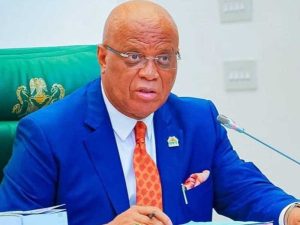
Give it to the governor. Maybe as a measure of self-restraint and circumspection, Governor Umo Eno doesn’t seem to be given to making big boasts or wild projections about his personal interest or the preponderant discourse on the necessity for a refinery or petroleum depot in Akwa Ibom State. But he’s making efforts to ensure that at least one of the wishes was granted by the powers.
During a visit by the Senate President, Senator Godswill Akpabio, to his office, the governor formally requested that the National Assembly support the state’s bid for a petroleum depot alongside the Ibom Deep Seaport. He had placed the same request at the doorstep of the federal government.
PRESENT CHALLENGES
As it stands, Akwa Ibom has had to lift petroleum products from either Port Harcourt or Calabar. This comes with enormous challenges. The first is distance, which is the primary reason for persistent disparity in prices between Akwa Ibom State and others.
There is no telling that premium motor spirit (PMS) and allied fuels are costlier in Akwa Ibom than in neighbouring states of the Niger Delta. By the time this column was being assembled, as confirmed by residents and commuters, pump prices of PMS in Calabar and Port Harcourt were on average N1,280, whereas in Akwa Ibom, they fluctuate between N1350 and N1400.
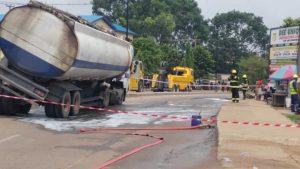
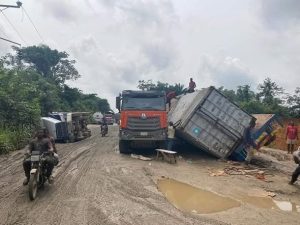
A major hindrance here is the long distances trucks have to cover to and fro to lift and supply the products. Perhaps the most worrisome is the Calabar-Itu Road, which has been a death trap for years now. Reports say there is hardly a day or week that one or more trucks would not fall off on the road and develop faults that would cause traffic gridlock that sometimes renders the one-way road impassable for excruciatingly long hours.
It is unexplainable that, although Akwa Ibom is arguably the most vibrant fountain of crude in the country, the heaviest consignment of petrol (PMS) to the state is lifted either from depots in Port Harcourt or Calabar. It is therefore high time the issue of a petrol or refinery was revisited aggressively beyond political utterances.
CALL FOR DIVERSIFICATION AS ALTERNATIVE
On Wednesday, May 20, 2026, the Solid Minerals Development Fund (SMDF), Abuja, and the Nigeria Maritime Administration and Safety Agency (NIMASA) jointly organised a symposium in favour of members of the Association of Eket Senatorial District Media Professionals. The symposium, which was facilitated by the Senator representing Akwa Ibom South Senatorial District and Chairman of the Senate Committee on Solid Minerals, Rt. Hon. Ekong Sampson had the theme “Harnessing Akwa Ibom South’s Natural Resources: The Role of Media Professionals”, with sub-themes such as “Collaborative Mining for Shared Prosperity: Aligning Investors,
Regulators and Local Stakeholders: “From Potential to Partnership: Unlocking Akwa Ibom Solid Minerals through investor collaboration”; “Exploring the Blue Economy and Maritime Potentials in Akwa Ibom State: The Role of Media Professionals” because the symposium had a tangential connection with the concerns of this page, it is expedient that we highlight here some parts of the communique issued at the end of the event, as was syndicated by the Chairman of the Association, Dr Edet Okpo.
The symposium was organised for media professionals, key stakeholders, and students from Eket Senatorial District. Resource persons, including professors and technocrats, delivered incisive papers on the main theme and sub-themes of the symposium and made recommendations to equip media professionals and guide stakeholders to drive the needed narratives and actions to bring about positive changes and impacts in harnessing the vast potentials of the Senatorial District.
The symposium recognised the pivotal role of the media in harnessing the enormous solid mineral and blue economy potentials in the Senatorial District.
In addition, it acknowledges the task before media professionals in driving narratives capable of engaging and promoting community involvement toward maximising the benefits of the solid minerals and blue economy.
In particular, it recommended the unbundling of the Ministry of Special Duties and Ibom Deep Seaport and creating a Ministry of Marine and Blue Economy. It also called on the federal government to decentralise solid minerals exploitation by delisting solid minerals exploitation from the exclusive list to enable states to engage experts in adding value to the same in various communities.
Furthermore, it saw the blue economy as the foundation and catalyst for Nigeria’s future sustainable development and wealth creation beyond oil and gas. It encouraged media professionals to support the successful implementation and development of the various aspects of the Blue Economy for sustainable growth and development of Akwa Ibom State and Nigeria at large.
In Strengthening Akwa Ibom’s economy through diversification, it is advised that the government and stakeholders pay attention to recommendations like this.