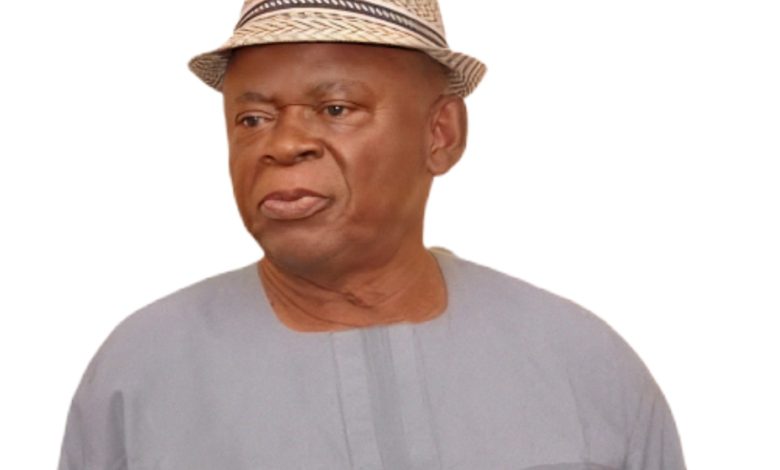
Obong Offiong Usen Akpabio is a first class graduate of petroleum engineering, businessman, industrialist, development expert and technocrat who knows his onions. As a former Think Tank member and special adviser to ex-President Ibrahim Babangida, he has the history of Nigeria’s leadership trajectory and evolution of democracy at his fingertips.
A proud alumnus of the University of Technology, England, and other foreign and Nigerian institutions, Engr. Akpabio holds the enviable record of having been amongst the 18 brightest Nigerian students to have been selected as Shell BP scholars out of the 250 that sat for a screening examination. He later returned to Nigeria to work for Shell BP for years before going into private practice as a consulting engineer and later joining the public sector, serving with the Cross River State government where he rose rapidly to the position of chief industrial engineer.
His cosmopolitan dispositions, distinctive leadership qualities in corporate and public service, and his depth in grassroots concerns were the deciding factors in his emergence as the erstwhile leader of Uyo Senatorial District Leaders’ Forum, a formidable socio-cultural and political group in Akwa Ibom State.
In the build-up to the third anniversary of His Excellency, Pastor Umo Eno, and Nigeria’s democratic evolution in the past 27 years, we reached out to the cerebral Engr. Akpabio. With his bold and frank assessment of issues and sound propositions, it wasn’t hard for the Crystal Express duo of Patrick Albert and Substance Udo-Nature to conclude that a conversation with Engr. Akpabio is a conversation with history and experience.
Excerpts…
Twenty seven years of Nigeria’s democratic journey from 1999 to date, what’s your fairest assessment?
Nigeria’s journey is Africa’s journey because Nigeria is the largest sector of the African nation. From Chief Olusegun Obasanjo through to late Yar’Adua to Goodluck Jonathan to the rest of our leaders up to and including the present leadership in Nigeria, we are what I would call learners in the art of democracy. We can and have made mistakes, but there is a corrective mechanism that always allows us to find our bearing each time we make those mistakes. But I would think 27 years is still an infant, as such, in my earnest opinion, whatever mistakes we make en-route should not be held too strongly against us as a people. What I’ve seen in the global space is that Nigeria will rediscover itself; it will make it. Even though fragmented into little enclaves, it surely will come back as a strong and united nation.
This is one nation you cannot wish away no matter how you try. That’s my estimation, and I think our children will benefit from this estimation because even if you look at older democracies like Great Britain, the USA that was put together as a migrant nation, the journey to where they are today has not been all smooth. It has been staccato here and there, but they discovered themselves early enough and became one nation, one people and one destiny. That is what I believe Nigeria will become. For now, it is what it is as it was put together – tribes, languages, religion, ethnic groupings and divisions. But who never started by crawling before learning how to walk and beginning to use others to stabilise himself? God knows we will make it because this is a God-fearing nation.
Outside Nigeria, I come down to Akwa Ibom State where it affects us directly. The state has been a strong advocate of goodness. If you do recall, we were part of the defunct South Eastern State; we left Calabar when President Ibrahim Babangida was gracious enough to give us a state as the inland part of Cross River State. So we left and came down to Akwa Ibom with peculiar challenges. One was the task of building a state that is cohesive, unified, progressive and cra-zy about growth and development. For what we have seen counting from Obong Victor Attah to Godswill Akpabio, Udom Emmanuel and up to the present with Pastor Umo Eno in the saddle, who is putting everything he inherited into one basket to make more meaning of out them, one thing I can say has run through all of them is the determina-tion to see the growth and development of Akwa Ibom State. The continuity is amazing and commendable.
I have this feeling that by the close of business in May 2027 and the beginning of another phase of the journey, Umo Eno would have started the processes of consolidating, putting together all the processes, whereby he begins what I would call legacy projects. The beautiful thing is that from Ukanafun up to Oron, up to Ibiono Ibom, inclusive of all ethnic diversi-ties, we understand one another through Ibibio as a common language and as a force of unity, therefore, it is not the question of language but that of little aberrations in dialects.
I must observe that Gov. Umo Eno has developed a blueprint that if realised can change the socio-economic status of Akwa Ibom in such a way that it will shock many. I make particular reference to the Ibom Deep Seaport. Fortunately, I started the Export Processing Zones (EPZ) Development in Nigeria. I gave the blueprint for the development of deep seaports in Nigeria. When President Babaginda came to commission the EPZ in Calabar, he made mention of deep seaports as a catalyst for development within the maritime territory of Nigeria. And fortunately, Ibaka Deep Seaport, as it was originally called, has the deepest sea territory within the West African sub-coast, outside of Cotonou. There-fore, big ships in the magnitude of 35 to 40 megatons would have opportunity to come into Akwa Ibom State. All we need to do is to liaise with federal authorities to kick-start Ibom Deep Seaport beyond paper work and stories. It must be admitted that we are not in rivalry with Lagos. No. Lagos has all the infrastructure to develop on its own. With Ibom Deep Seaport, employment, development and tourism the state can become a world class commercial hub for the West African sub-coast. The kind of development that will escalate can only be imagined. With due diligence and what I would call persistent, well-structured and frank commitment, posterity shall be happy that successive leaders fol-lowed up with the projects to a logical conclusion.
Outside of that, Akwa Ibom is a maritime state and developments in the fisheries and sub-aquatic domain is something investors should be able to reach and fully tap into. The Export Processing Zone territories are places you can designate as an international territory that would synchronize all infrastructure, industrial hubs of developments. Akwa Ibom has tremendous amount of sea-based stock that can be developed very, very articulately. This international territory will attract and link up people from outside Nigeria, boosting commerce, investments and general de-velopments with great value-chain effects, including the absorption of our abundant local manpower and local prod-ucts which combined shall create employment and self-sufficiency. The discourse then will be that we are also active contributors to whatever shall happen at the Ibom Deep Seaport and nobody would think that he or she is doing Akwa Ibom any favour as if we had nothing to offer. It is our project. It is a case of symbiosis, a give me,-I give you- scenario.
Read Also: Akwa Ibom to Become West Africa’s Aviation Hub – Gov. Eno
What advice or special goodwill message would you give Gov. UmoEno on the third anniversary of his administration?
Let me first appreciate that His Excellency, Pastor Umo Eno, PhD, is 62. At that age in leadership dynamics, he is in his best of form to give his best out to Akwa Ibom people and the state. And Akwa Ibom people will remember him for all time. At this moment in time, all we need is not too much intelligence that does not add value; all we need is actively and intentionally putting together human and material resources that we have for a particular aim; to bring people out of poverty, to catalyze development, to impact lives and develop leaders. For now, I can see that the governor is focusing on tourism. He is a tourism freak and you can see he is deploying experience and expertise in achieving that, all in an attempt to make the state a tourism destination. To me that’s fine. But he must diversify effectively and consciously. For now, he has gone one notch above other governors in Nigeria. Secondly, he is showing earnest commitment to the aviation sector that he met on ground and he has expanded the coast now to where Akwa Ibom is enjoying international flights. That is a very big statement for sub-nationals. That’s continuity, with great potential for much more investment to realize the bigger goal of the airport and crown the efforts of predecessors. I score the governor high.
Let’s digress a little since we are still talking about democracy. Senator Godswill Akpabio as Senate President! What does that mean to you personally?
That question is too large for me to talk about. This is the first time that Akwa Ibom has risen to that level of commit-ment to Nigeria. Imagine that outside of President Bola Tinubu and the Vice President Kashim Shetima, an Akwa Ibom person is the third highest ranked Nigerian, Sen. Godswill Akpabio, from the minority. That alone nullifies the house-boy stereotype that Akwa Ibom unfortunately was associated with. Akpabio’s position today is tied to Nigeria’s development in all ramifications. There are three sectors of governance – the Legislature, the Executive, and the Judiciary. Each of them, in the Constitution, is independent. Akapbio now sits at the apex of authority linking the three layers of government by virtue of his office. This is where Akpabio comes into the discourse of national development. He is, of course, associated with the name ‘’Uncommon’’. You can say he has brought that uncommonness into everything he does. I am happy that he has been adopted and endorsed to return to the Senate and you can see that 2027 is a given. His choice is unanimous. Akwa Ibom stands behind him. Everybody in Akwa Ibom stands behind him. In fact, with Akpabio, we are not talking about Akwa Ibom North West or Ikot Ekpene Senatorial District; we are talking about the whole Akwa Ibom and South-South. We want him there. A mark must be made.
Please, talk to Akwa Ibom people as we celebrate the third anniversary of His Excellency, Pastor Umo Eno.
As we celebrate the third anniversary of Governor Eno come May 29, 2026, all I could say is, we have come of age, and with the governor, my feeling is that we are going to blow open the ceiling for development, for growth and stronger unity. That said, we have to give the governor all the support he needs as we expect him to open up the interior more through good roads network. To connect the people is to connect to markets and different development zones in Nigeria, which have already been established across geo-political zones. That will bring about some quasi-independence to see regions develop and evolve on their own and contribute to the centre.
Akwa Ibom should be firmly rooted with what God has blessed her with and the kind of leadership she has had over the years. That’s because I see regional development as the answer to Nigeria’s rapid growth. The six development commissions that had been started is an invitation to growth and development and Akwa Ibom should be sensitive enough to position itself to tap fully from it.
With your experience as a widely travelled person and a statesman in your own right, are there some particular per-sonal desires or dreams you would have loved to see actualized?
What I do believe is that Nigeria is a cesspool of development. The country has all the materials to self-develop even without much of external support. We have the third largest deposit of petroleum and oil in the entire Africa, outside of Libya and Angola. The irony, however, is that we haven’t utilized what we have to benefit ourselves maximally. That’s pitiful. For instance, I recall when I was working for Shell BP, I was a petroleum engineer, wellsite engineer, and I got to know there are so many things to do in the oil sector that Akwa Ibom has not taken advantage of or has not even started thinking about.
All I wish for Akwa Ibom to do is set up a special team that can develop a blueprint for us to get into the oil industry as a state. It bothers me, for example, that till now the state does not have a refinery, even a modular refinery that something could start from. Niger Delta has the highest record of gas flaring, which affects Akwa Ibom squarely. The gas can be redirected into energy. They have done it in Brazil; they’ve done it in Russia be-cause she is the largest importer of gas now.
At this point of our statehood, 38 or 39 years after, Akwa Ibom should be thoughtful enough not to continue to depend solely on what trickles down from Abuja. This is why I support regionalism. I can’t see why the state doesn’t have her own depot, refinery and things like that. I’m not talking about individuals, I mean as a state. I want to tell you that the raw materials are not lacking in Akwa Ibom.
Let’s walk down history lane: When Dr Clement Isong was the governor, we proved beyond any doubts that we safely can stand on our own. So many companies were set up in this area of Akwa Ibom through quality leadership. Incidentally, I was the chief industrial engineer at that time. The governor recruited me from Shell and we set up the Qua Steel in Eket. That was because we saw Eket as a development centre in terms of heavy industries. We set up the Limestones Producing Industry somewhere in Itam. We set up battery industry in Ikot Ekpene. We set up the biscuit industry in Uyo, and many others, and that meant huge revenue to government with chain effects on the populace. All of that were things put down to drive the economy. But look at the hatchery that Akpabio set up in Uruan. One of the aims was to produce 520,000 birds per month and distribute them throughout the West African sub-region. But if you go there now, it is dead and gone. That’s why I strongly rec-ommend deliberately setting up a team with specific terms of reference and close monitoring for performance audit.
For the next four years, we can reactivate some of those industries. That means creating jobs, putting money in the pockets of youths, and others. I’m not aversed to government’s handout but for things to be permanent, for development to be sustainable, so as to allow them earn their own living. So much shall change both citizen’s and government levels.